€ 140


Still questions? Contact us
E=mc² necklace | sterling silver
E=mc² is the equation that says mass and energy are different forms of the same thing. The rest of physics adapts to that statement. Nuclear reactors. The sun's core. PET imaging in oncology. The binding energy that holds atomic nuclei together. All of it lives downstream of one short equation, written here at 25 mm in 925 sterling silver.
The Science Behind E=mc²
Albert Einstein derived E=mc² in 1905 as a consequence of special relativity, in a paper titled "Does the Inertia of a Body Depend Upon Its Energy Content?" The equation states that energy equals mass multiplied by the speed of light squared, with c² approximately 9 × 10¹⁶ m²/s². Because that conversion factor is so large, even a tiny mass holds an enormous amount of energy. One gram of matter, fully converted, releases roughly 90 terajoules, on the order of 21 kilotons of TNT. The same equation explains nuclear binding energy, why stars shine through fusion, and why PET scanners can detect positron-electron annihilation in tissue. It is the most thoroughly verified equation in physics.
Who Will Recognise It
- physicists, astrophysicists, and nuclear physicists
- nuclear medicine staff and PET technicians
- science educators teaching modern physics
- engineering students who first met it in introductory mechanics
About a third of orders ship to physicists or nuclear medicine staff. The rest go to gift-givers who recognise the equation as a marker of the recipient's field.
Explore Related Math and Physics Jewelry
- E=mc² necklace | gold vermeil
- E=mc² ring | silver
- Feynman scattering necklace | silver
- Atom necklace | silver
- Pi necklace | silver
FAQ
Is this too on-the-nose for someone who works with mass-energy equivalence?
Probably the opposite. People who work with the equation tend to like seeing it on the desk or the wall. The piece reads the same way for nuclear physicists, particle physicists, and working astrophysicists. The audience for whom this is decoration is smaller than the audience for whom it is a reference to daily work.
Why mass and energy and not just one or the other?
Special relativity removed the distinction. Mass became a particularly concentrated form of energy with c² as the conversion factor. Because c² is roughly 9 × 10¹⁶ m²/s², a single gram of matter, fully converted, releases about 90 terajoules. That is the size of mass-energy equivalence in everyday units.
What size is the pendant and what is the return policy?
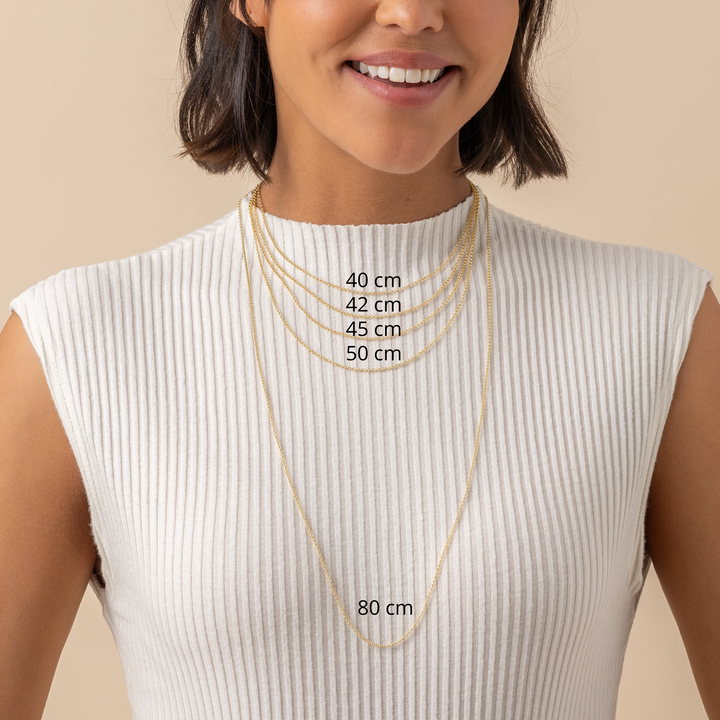
925 sterling silver, 25 mm pendant on a 45 cm sterling silver chain with a 5 cm extender. Nickel-free and hypoallergenic. Ships free worldwide via DHL Express in 1-5 business days, with all import duties and taxes covered. 30-day “Love It or Return It” returns.
Is there a gold version, or a ring?
Both. The same 25 mm E=mc² pendant is available in 18K gold vermeil at the same chain length. An E=mc² ring in sterling silver also exists, in US sizes 5 to 9, for anyone who prefers the equation on the hand rather than at the chest.
Math & Physics
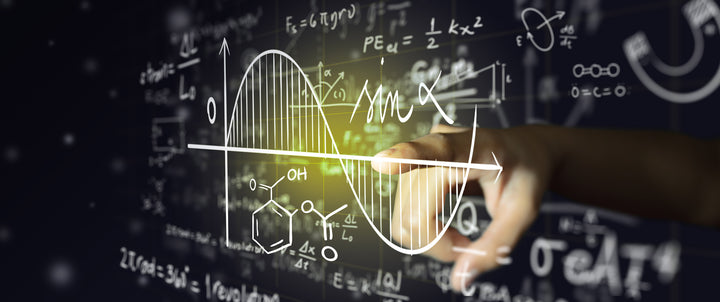
Unlock the elegance of the abstract with our math and physics-inspired jewelry collection. These carefully crafted pieces mirror the profound equations and natural laws that shape our understanding of the universe. Experience the allure of fractals, the rhythmic beauty of pi, and the celestial wonder of astral formations—each piece serves as a wearable homage to the artistry inherent in scientific inquiry.
Find your perfect fit: measure an Existing Ring
Finding out your ring size at home is a simple process and can help you shop for jewelry online with confidence.
Necklace length guide