€ 155


Still questions? Contact us
Neuron necklace | sterling silver
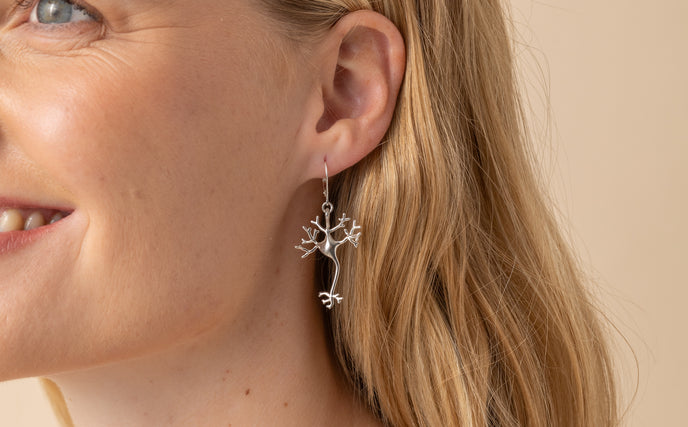
The human brain holds roughly 86 billion neurons, each firing through the same basic architecture: cell body, dendrites, axon, synaptic terminals. The unit that took most of the twentieth century to understand and now anchors most of neuroscience. Worn here as a 39 mm sterling silver pendant.
The Science Behind the Neuron
The neuron doctrine, the principle that the brain is composed of discrete cellular units rather than a continuous reticulum, was settled by Santiago Ramón y Cajal's silver-staining studies in the 1880s and 1890s. Cajal's silver impregnation revealed individual neurons in cortex, cerebellum, retina, and spinal cord, settling a long debate with Camillo Golgi (who maintained the reticular theory). The two shared the 1906 Nobel Prize in Physiology or Medicine. Each neuron computes through dendritic input integration, cell-body summation, and axonal action potential propagation, with myelination by oligodendrocytes (CNS) or Schwann cells (PNS) speeding conduction. Synapse counts in the human cortex run between 10¹⁴ and 10¹⁵. The diversity is enormous: pyramidal cells, interneurons, motor neurons, sensory neurons, Purkinje cells, granule cells, each tuned to a particular computational role.
Who Tends to Wear This
- neuroscientists across systems, cellular, molecular, and computational subfields
- neurologists and clinical neuroscience trainees
- medical and graduate students learning the neuron doctrine and synaptic transmission
- science communicators and educators teaching brain biology
For someone who knows that Cajal's silver-staining method is part of why the silver version reads cleanly here, and for whom the neuron is the unit that frames an entire field rather than just a textbook image.
Explore Related Neuroscience Jewelry
- Neuron necklace | gold vermeil
- Neuron earrings | silver
- Purkinje cell necklace | silver
- Spindle neuron necklace | silver
- Sagittal brain necklace | gold vermeil
FAQ
Why is silver the right material for a neuron pendant?
Beyond aesthetic preference, the silver version carries a quiet methodological link. Cajal's 1873 silver-staining technique, developed to visualise individual neurons, made the neuron doctrine possible. The whole modern picture of the brain as a network of discrete cells rests on a metallic stain. The silver pendant catches that history without leaning on it. Buyers in working neuroscience tend to recognise the link without needing it explained.
Is the neuron pendant for any specific subfield?
It works across most of neuroscience because the cell type is the foundational unit. Cellular neuroscientists and electrophysiologists buy it as a working reference. Systems and cognitive neuroscientists buy it as the iconic image of the field. Clinical neuroscientists and neurologists buy it as the molecular substrate of the conditions they treat. Educators buy it because the neuron is the first thing a student learns and the last thing they forget.
What size is the pendant and what chain comes with it?
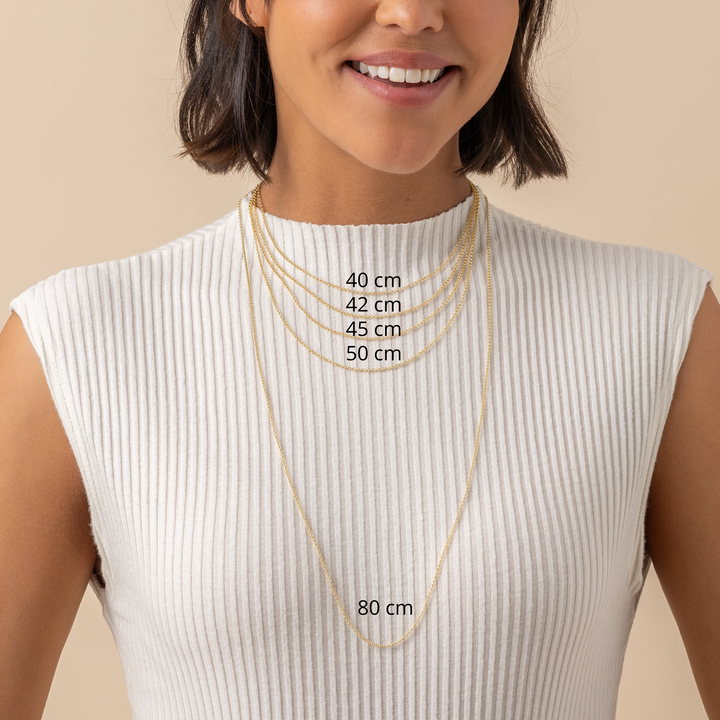
925 sterling silver, 39 mm pendant on a 45 cm sterling silver chain (ø 1.8 mm) with a 5 cm extender. Nickel-free and hypoallergenic. Free worldwide DHL Express in 1-5 business days, with all import duties and taxes covered. 30-day “Love It or Return It” returns.
Is there a gold version?
Yes. The same neuron is available in 18K gold vermeil at the same scale and chain length. Silver tends to suit working clinical and lab wear (and carries the Cajal stain link). Gold tends to suit graduation, retirement, or a major appointment in neuroscience or clinical neurology.

Neuroscience
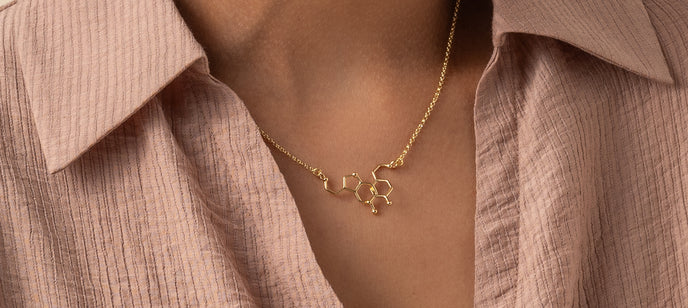
Dive into the intricacies of the human mind with our neuroscience-inspired jewelry collection. Each piece is a tactile ode to the neural networks that shape our thoughts, memories, and consciousness. Crafted with meticulous attention to detail, our designs mirror the dendritic branches and synaptic connections that form the basis of mental activity. With these elegant pieces, wear the enigma of cognition close to your skin, offering a subtle yet profound exploration of what it means to be sentient.
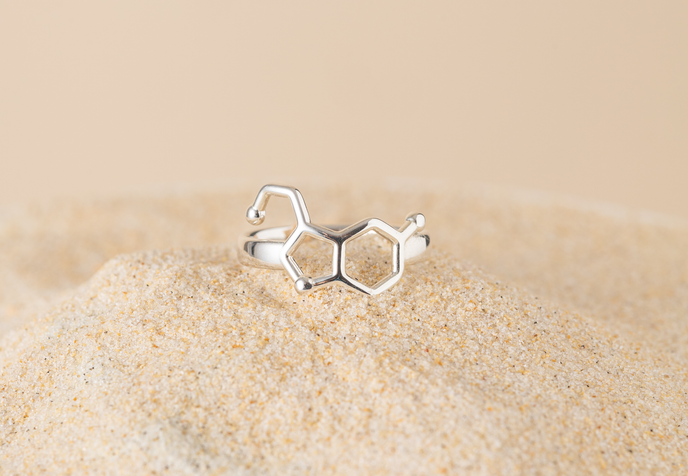
Find your perfect fit: measure an Existing Ring
Finding out your ring size at home is a simple process and can help you shop for jewelry online with confidence.
Necklace length guide